Chiropractic Website Audit: What 37 Practices Showed Us in 2026
In September 2026, Greenlight Systems prepared a website audit for each of 37 practices whose doctors were registered for the CFR Advanced Seminar in Las Vegas. Most of them are chiropractic offices in the United States. We checked what a new patient runs into first: how fast the home page shows up on a phone, whether the phone number can be tapped, and whether the page tells Google what the practice does and where.
The short version: most of these sites were slow on a phone, and many didn't tell Google what they do or where.
- Slow on a phone. In Google's phone speed test, 21 of 28 home pages took 4 seconds or longer to show their main content. The middle result was 6.1 seconds. Google's "good" mark is 2.5 seconds.
- No tap-to-call. On 7 of 33 home pages, a patient on a phone couldn't tap the number to call.
- Titles that leave out the what or the where. 8 of 32 chiropractic home pages had a title that left out "chiropractor" and "chiropractic." 11 of 33 titles named no town or area.
- No page about CFR. 16 of 34 with a working site had no page built for what CFR patients search for. CFR is the technique the seminar teaches.
Our connection, up front: CFR is a Greenlight Systems client and earns a service credit when a doctor it refers becomes a client; we were an approved vendor at the seminar. Each practice's audit stays private. This post shares totals only, names no practice or doctor, and never reports a group smaller than five.
Every number below says how many sites it was checked on, which tool did the checking, and when. Most of these checks you can run on your own site in about ten minutes, and the list is further down.
The findings, in one table
Each row is one check. The second column shows how many sites had the issue, out of how many we could check that way.
| What we checked | Result |
|---|---|
| Home page took 4 seconds or longer to show its main content on a phoneGoogle Lighthouse, phone setting, simulated slow connection, September 25, 2026 | 21 of 28sites tested |
| Slower than Google's 2.5-second "good" markSame test | 25 of 28sites tested |
| Phone number not tappable on the phone version of the home pageHome page loaded at phone size in a browser, links read, September 24, 2026 | 7 of 33home pages |
| Home-page title leaves out "chiropractor" and "chiropractic"The title is the blue headline Google shows for your page | 8 of 32chiropractic home pages |
| Home-page title names no town or areaRead by a person | 11 of 33home pages |
| Title names neither the service nor the placeRead by a person | 5 of 33home pages |
| No page built for what CFR patients search forEach site's menu, page list and home page, checked by a person, September 2026 | 16 of 34with a working site |
Why different totals? The speed rows count only sites where two phone tests agreed. The page rows count the home pages our browser could read that day, and the "chiropractor" row counts chiropractic offices only. The CFR row counts every practice with a working site.
Speed on a phone
The middle site took 6.1 seconds to show its main content in Google's phone test, and 21 of 28 took 4 seconds or longer. Google says a page should show its largest piece of content within 2.5 seconds to give visitors a good experience.
The test is Lighthouse, the same engine behind Google's free PageSpeed Insights. It loads the page the way a mid-range phone would on a slow mobile connection. That makes it a tough test on purpose. A patient on fast Wi-Fi will often see the page sooner, and Google's 2.5-second mark is meant to be judged on real visits: three out of four should hit it. So read our numbers as a stress test, not a stopwatch on every patient.
The test also lists what slowed each page down, and the same three things came up again and again. On 20 of the 21 slow sites, it flagged photos that are heavier than they need to be. On 19, it flagged code the page downloads but never uses. On 16, it flagged files that hold the page up before anything shows. Each one is a specific item the test will list for your own page.
Why it matters: every second of blank screen is a second a patient can tap back to the search results and choose someone else. You can check yours for free. Go to pagespeed.web.dev, paste in your home page address, and look at the Mobile tab. The number to watch is Largest Contentful Paint.
Do I need a website if I have a Google Business Profile?
Yes, if you want patients who don't already know your name to find you. Your Google Business Profile puts you on the map. Your website is where Google and AI tools read what you actually do, for whom, and where. A profile has room for a summary. A website has room for a page on each thing patients come to you for.
Google's own help page says local results come down to three things: relevance, "how well a Business Profile matches what someone is searching for," distance, and prominence, "how well-known a business is." On prominence, Google adds that it's "also based on info like how many websites link to your business and how many reviews you have" (Google Business Profile Help). A website helps with both of the factors you can change. It spells out what you do, and it gives other sites something to link to.
The other difference is ownership. A profile lives on Google's platform, under Google's rules. Your website is yours: the address, the pages and the words. If you're starting with the profile, our guide to local SEO basics covers what to fill in first.
What if another doctor in my town offers the same technique?
Then patients nearby can find both of you, and the details decide who they call. Nobody can move an office closer to a patient. How clearly your site explains the technique, and how well-known your practice is, are both in your hands.
This is where the CFR finding matters most. Of the 34 practices with a working site, 16 had no page built for what CFR patients search for. A doctor who trained in the technique but has no page for it gives Google, and the patient, nothing to match. A page that explains what CFR is, what a first visit looks like and how to book gives them something to go on.
It isn't a contest one doctor has to lose. Two practices that each explain the technique well can both earn patients from the same town.
Why do AI tools recommend other practices but not mine?
Often because the other practice's pages say more, in plain words, about what it does and where. Tools like ChatGPT, Gemini and Perplexity build answers from pages they can read and from what other sites say about a business. A home page that never names the service or the town gives them little to work with.
We didn't test AI answers for these 37 practices, so we can't tell you how any of them show up there. What we can point to is the groundwork: 8 of 32 chiropractic home pages had a title that left out "chiropractor" and "chiropractic," and 11 of 33 titles named no town or area. Where you say it matters too. One study of 18,012 ChatGPT citations found 44.2% came from the first 30% of the page. Say what you do and where you do it near the top.
Here's what we've measured for our own clients. We ask ChatGPT, Gemini and Perplexity the same customer questions over time, leaving out any question that names the business. Across nine client sites, 234 matched answers named or cited our client 13 times when first asked (between March and July 2026) and 39 times when asked again on October 1–3, most of the gain on Perplexity. We wrote those questions, and the engines' models changed between runs, so read it as a direction, not a promise. Results vary by business, market and competition. For more, see AI search for health practices and how to check whether AI recommends your business.
How can I tell if my website is doing its job?
Check it the way a new patient meets it: on a phone, from a Google search. If you can tap to call, the Google headline says what you do and where, and the page shows up within a few seconds, the basics are working. The list below takes about ten minutes.
- Tap your number. Open your home page on your phone and tap the phone number. It should start a call. In our audit, 7 of 33 home pages failed this.
- Read your Google headline. Search for your practice by name. The blue headline should say what you do and your town, for example "Chiropractor in [your town] | [practice name]."
- Test the speed. Run your home page through PageSpeed Insights, open the Mobile tab and look at Largest Contentful Paint.
- Count your service pages. Each main reason patients come to you deserves its own page, CFR included if you offer it.
- Match your details. Your hours, phone number and address should read the same on your site, your Google Business Profile and every directory that lists you. Google says complete and accurate info makes a business more likely to show up in local results.
- Check your Google category. In your Google Business Profile, make sure the main category describes your practice.
If you pay someone to look after your site, it's fair to ask for these numbers in plain words every month. That goes for us too.
Does a website cost one time, or every month?
Usually both. There's a one-time cost to design and build the site, and a monthly cost to host it and keep it working. What the monthly part covers varies a lot, so ask what you get for it before you sign.
Ours works the same way. The build is paid once, and the monthly work runs month to month. You can cancel the monthly part with 30 days' written notice, and once the build is paid for, the design and code are yours. Both are in our published terms.
Three questions worth asking anyone you're considering: Who owns the site if you leave? What does the monthly fee buy, month by month? Will you see real numbers, and which ones?
What we took from the weekend
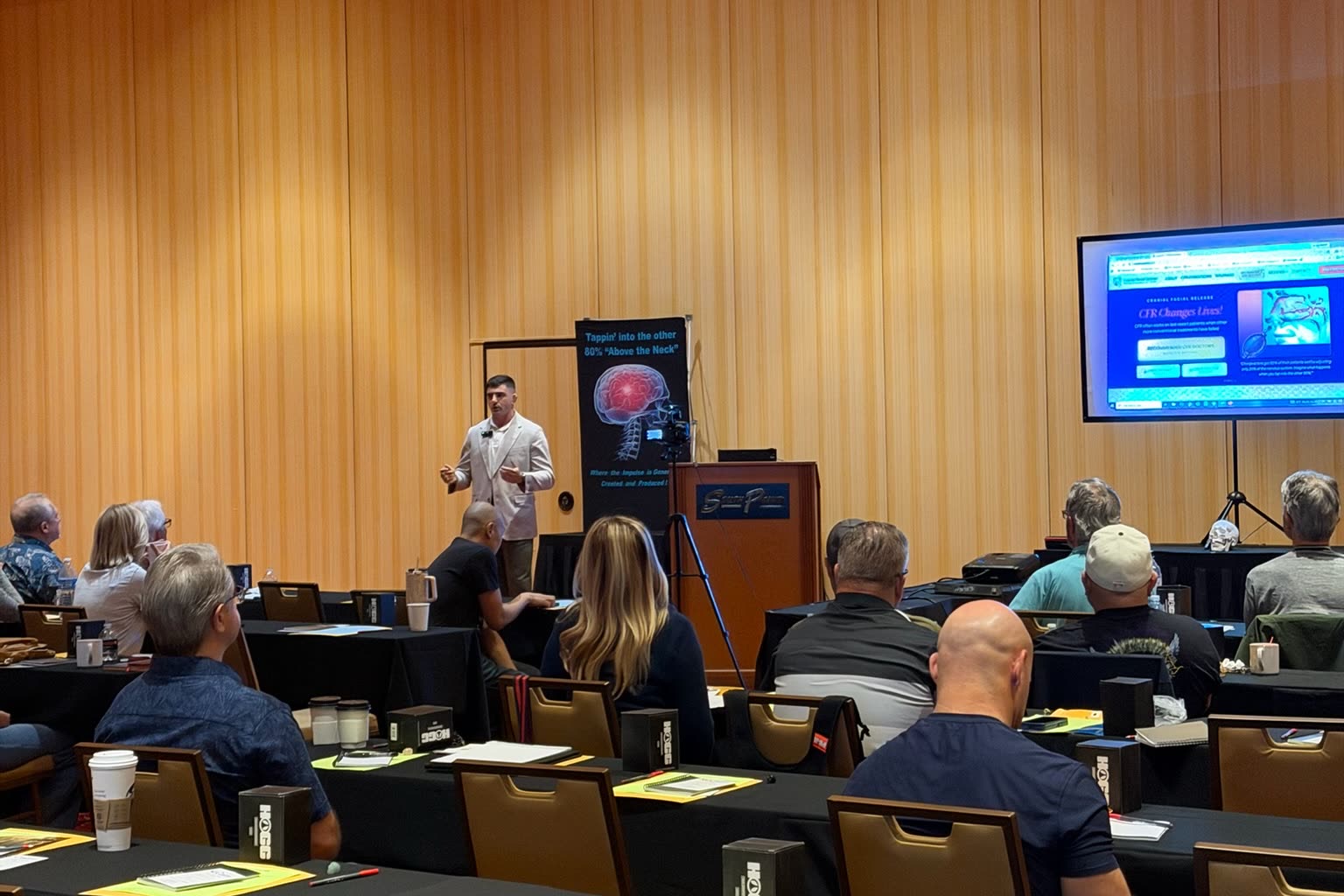
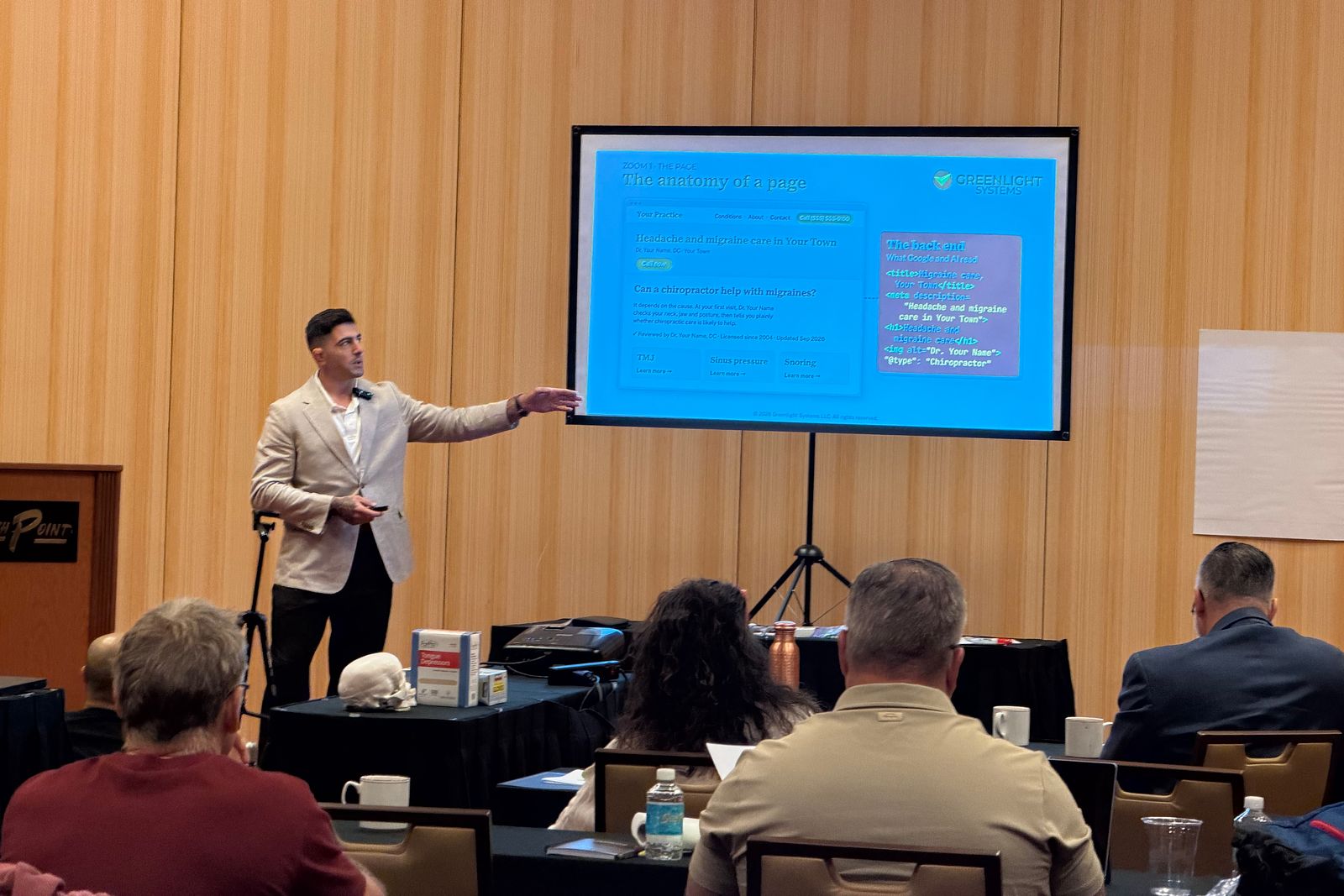
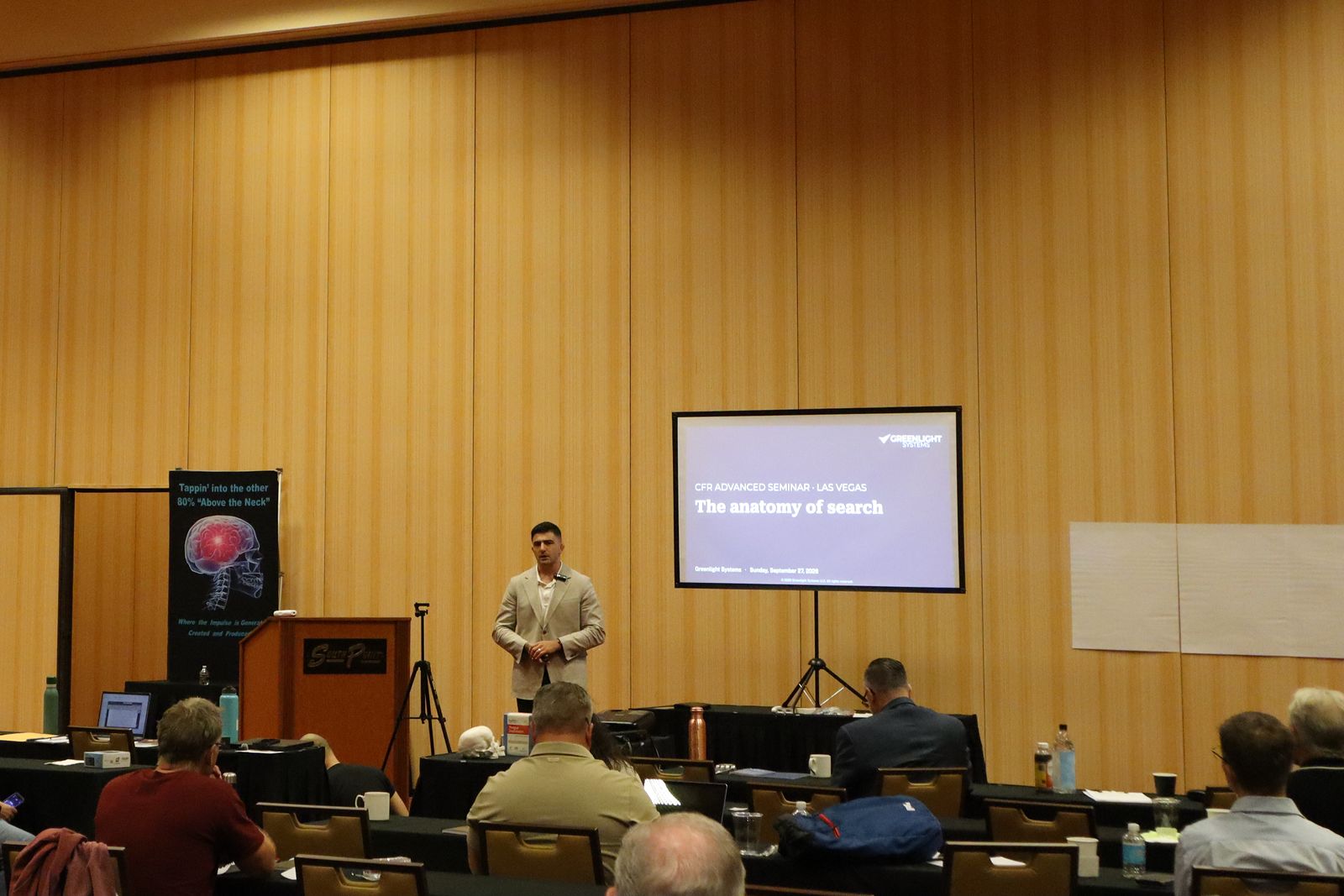
Greenlight Systems was an approved vendor at the CFR Advanced Seminar at South Point in Las Vegas, September 25–27, 2026. We ran a booth, and Jonathan spoke on stage. The idea he brought was simple: a practice's website sits at the center of everything else it has online. The Google listing, the CFR directory listing, the videos and the reviews should all point back to one site that says plainly what the practice does and where.
The questions doctors asked us that weekend shaped this post. Two of the sections above started there: what to do when another doctor in town offers the same technique, and whether a website is a one-time cost or a monthly one.

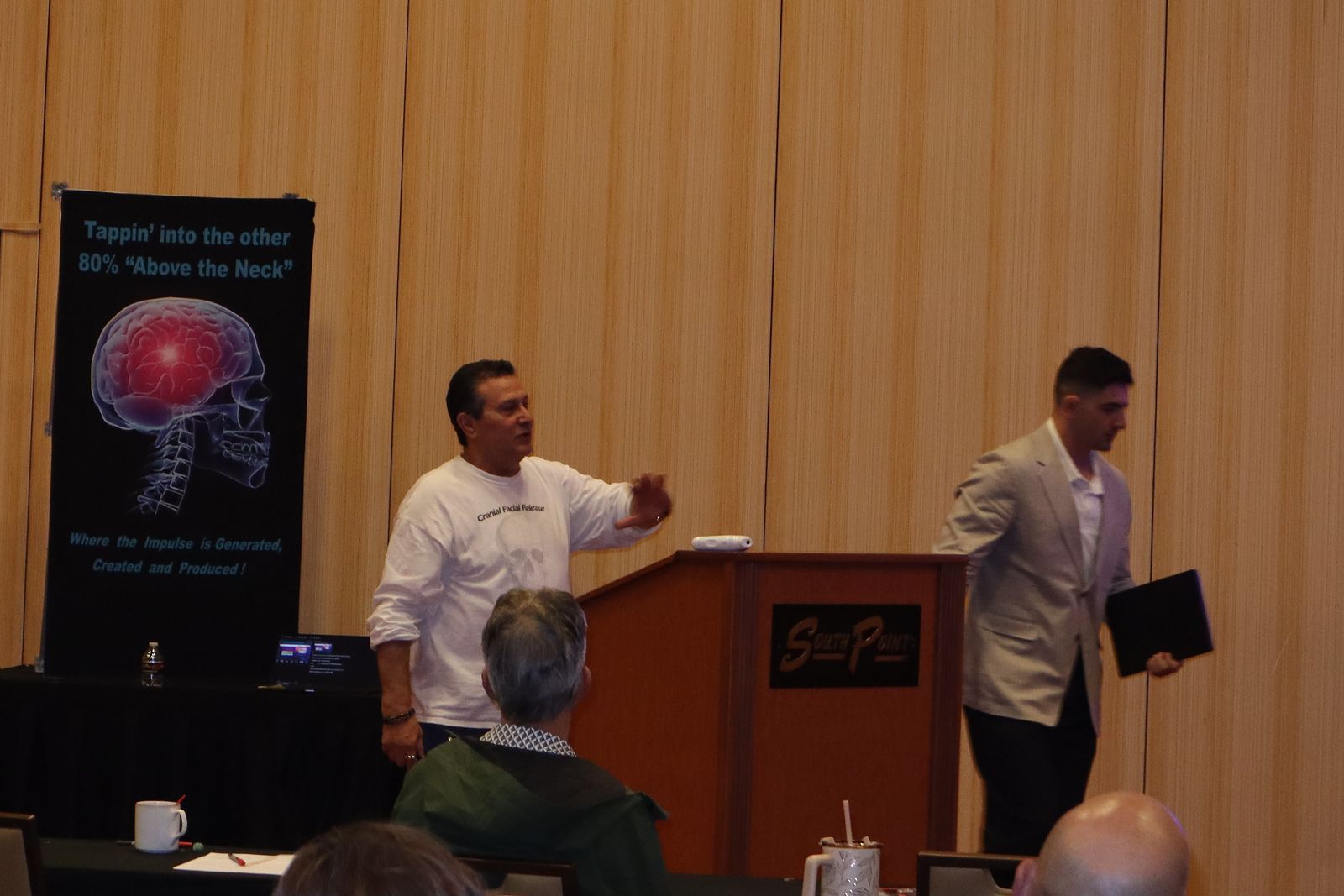
CFR is a Greenlight Systems client and earns a service credit when a doctor it refers becomes a client; we were an approved vendor at the seminar.
How we ran the audits
- Who's included. The 37 practices on the attendee list whose websites we had found by September 24. Most are chiropractic offices in the United States. CFR's own website is left out, because we built it.
- Page checks (33 home pages). We loaded each home page in a browser at phone and desktop size on September 24, 2026, and read its title and its phone links. Whether a title names a town or area was read by a person.
- Speed (28 sites). Google Lighthouse 12.8, phone setting with a simulated slow connection, September 25, 2026. Each site ran at least twice, one test at a time. We dropped any run Lighthouse marked as incomplete and kept a site only when its two tests agreed within a factor of two. The number for each site is the average of its runs.
- CFR page (34 practices with a working site). For each one we looked through the site's menu, the page list Google reads, and the home page for a page built for what CFR patients search for. A person reviewed every result.
- What we didn't measure. Speed for real visitors, phone calls, new patients, and AI answers for these practices. We also looked at Google map results, but the methods differed from town to town, so we left them out.
- Privacy and recount. Each practice's audit stays private. Here we report totals only, name no practice or doctor, and never report a group smaller than five. Every number on this page was recounted on October 6, 2026.
Want to see how your practice's site checks out?
Run the free Website Scorecard: six questions, about two minutes, and your grade shows right away. No call required.

Jonathan Tomasian, Founder, Greenlight Systems. Jonathan founded Greenlight Systems in December 2025 after more than a decade in sales operations and agency marketing. He builds and runs websites and search for local businesses and practices, and he spoke at the CFR Advanced Seminar in Las Vegas in September 2026. More about us.
See where you stand
Are you the answer?
Run the free Website Scorecard: six questions, about two minutes, and your grade shows right away. No call required.
Get my free Scorecard →Rather talk it through? Book a time with Jonathan →